


Quick Summary Opening a restaurant in Australia takes 6 to 12 months & costs anywhere from $150,000 to $500,000 or more. You need food business registration, a food safety supervisor & the right licences sorted before you open. You do NOT need cooking experience. The right team can fill that gap for you. Ghost kitchens & pop-ups are honestly the smartest way to start if your budget is tight. Sydney, Melbourne & Brisbane each have their own rules. I cover all three below. Franchises give you structure but cost you creative freedom & ongoing royalties. Choose wisely. |
I get asked this question a lot. People read about Australia having one of the best food cultures in the world & they think, I want a piece of that. And honestly? They are not wrong. Australia has over 46 billion dollars worth of hospitality industry to tap into. There is real opportunity here.
But I also see a lot of people jump in without a solid plan & struggle within the first year. So I put together everything I know, all in one place, so you can go in prepared. Whether you are thinking about a small cafe, a full-service restaurant or even a franchise, I have covered it all below. Let us go step by step.
Is Opening a Restaurant in Australia Right for You?
How Hard Is It to Start a Restaurant?
I want to be upfront with you here. Around 60% of new restaurants in Australia close within their first year. That is a real number & I am not going to sugarcoat it. But here is the thing. Most of those closures are not because the food was bad. They happen because the owner did not plan properly.
The most common reasons I see restaurants fail are:
- Picking the wrong location for the concept
- Running out of cash before the business finds its feet
- Getting blindsided by compliance requirements
- Having no marketing plan after opening day
One thing I always recommend before you do anything else is to sit down & do a proper restaurant SWOT analysis. It sounds formal but it is just an honest look at your strengths, weaknesses, the opportunities in your area & the risks you face. Do this first & a lot of the other decisions become clearer.
Can You Open a Restaurant With No Experience?
Yes, absolutely. I know people who have come from finance, teaching & retail & gone on to run really successful restaurants. What they all had in common was that they hired the right chef, got their food safety qualifications sorted & treated it like a business from day one.
If you have no hospitality background at all, I would suggest doing a Certificate III or IV in Hospitality. It is not mandatory but it gives you a solid foundation. At the very least, get your food safety supervisor course done because you will need it anyway.
Expert Insight “The best restaurant owners I have worked with are not always the best cooks. They are the ones who understand their numbers, look after their staff, & stay close to their customers.” |
Can You Start a Restaurant With No Money?
I get this question a lot too. Starting a full restaurant from scratch with zero capital is genuinely tough. But starting small? That is very doable. Some of the best restaurant stories I know started as a ghost kitchen or a market stall.
Ghost kitchens let you cook from a shared commercial space & sell through delivery apps with almost no fitout cost. Pop-ups at markets or events are another great way to test your concept before you commit to a lease. For funding, look at state-based small business grants, the ASBFEO support programs or a quiet investor partnership.
Can You Run a Restaurant From Home?
In some cases, yes. Australia does allow home-based food businesses but there are rules around it. You need to register with your local council as a food business & meet the food safety standards for your state. The main limit is scale. Once you are cooking for large volumes or operating a public shopfront, you will need to move into a commercial premises.
Step 1: Develop Your Restaurant Concept & Business Plan
Define Your Concept First
I have seen people skip this step & it almost always comes back to bite them. Before you look at locations or talk to suppliers, you need to know exactly what kind of restaurant you are opening. Are you going fine dining, casual, fast casual, a cafe or a food truck? What cuisine? And most importantly, what makes you different from the ten other places already doing something similar in your area?
Your brand name, your fit-out style, your menu pricing & your marketing all flow from the concept. Get this right first & everything else is much easier to decide.
Write a Proper Business Plan
I know the words business plan sound boring but honestly, this document is what separates the restaurants that survive from the ones that do not. It forces you to stress-test your numbers before you spend a single dollar. At a minimum your plan should cover your market analysis, operations plan & a full financial model with startup costs, monthly expenses & a clear break-even point.
Business.gov.au has a free template you can use as a starting point. I would also strongly recommend talking to an accountant who has worked with hospitality businesses before. They will spot things in your numbers that you will not see yourself.
So How Much Does It Actually Cost?
Here is a rough breakdown based on what I have seen across different types of venues:
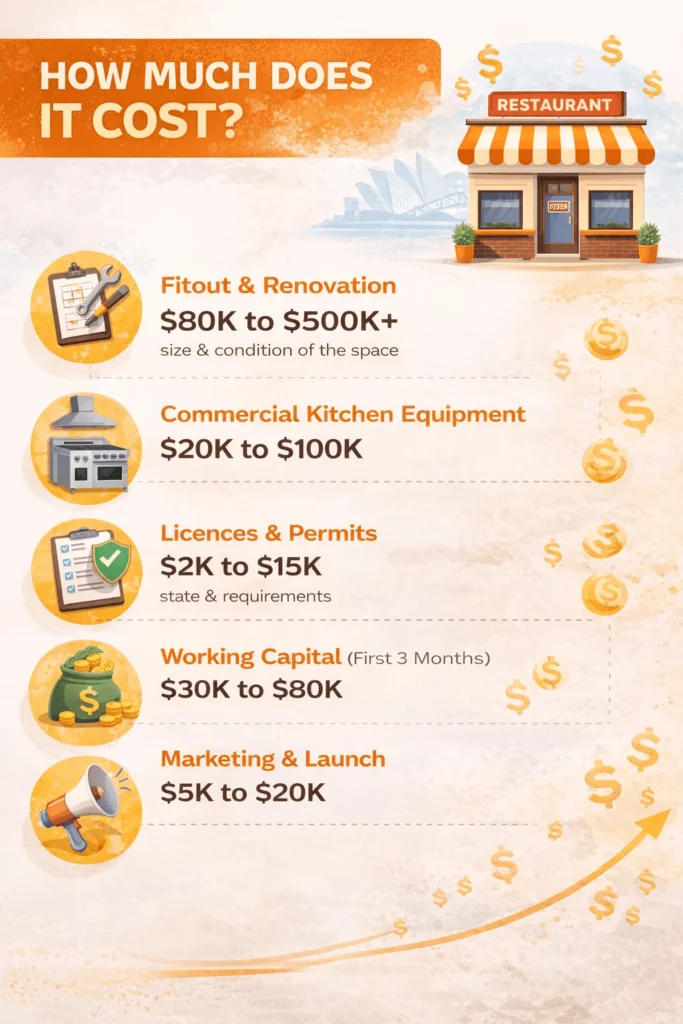
For a small cafe or restaurant, you are generally looking at $150,000 to $250,000 if you are sensible about it. A larger venue can push well past $500,000. Know your number before you commit to anything.
Step 2: Choose a Location & Secure Your Premises
How to Pick the Right Spot
I always tell people this: a great restaurant in the wrong location will still struggle. I have seen it happen. When you are looking at spaces, visit them at different times of day & different days of the week. Check the foot traffic, look at who is actually walking past & ask yourself honestly whether those people are your customers.
Also check the zoning for the area. Food premises require a specific use class under local planning rules & this varies by council. Parking, delivery access & whether customers can find you easily all matter more than people think.
Read Your Lease Before You Sign Anything
This is the one thing I wish more people took seriously. A lease is a long-term financial commitment & the terms matter enormously. The three things I always tell people to check are the make-good clause (what condition do you need to leave the place in?), the rent review terms (how often & by how much can the landlord increase your rent?) & whether you have an option to renew.
Please get a lawyer who specialises in hospitality leases to look over it before you sign. The cost of an hour of their time is nothing compared to being locked into bad terms for five years.
How Long Does the Whole Process Take?
Once you sign a lease, it typically takes 3 to 9 months before you open. In that time you are dealing with development approval from your council, the fitout, equipment delivery & installation, the council inspection & staff hiring. The two things that slow people down most consistently are DA delays & fitouts going over budget. Build buffer time into your plan for both.
Step 3: Licences, Permits & Legal Requirements in Australia
This is the part most new owners underestimate & I want to make sure you do not make that mistake. Australia has strict food & hospitality regulations & the compliance side of things needs to be sorted before you open, not after.
Food Business Registration & Food Safety Plans
Under the Food Standards Australia New Zealand (FSANZ) framework, you must register your food business with your local council before you start operating. You also need a food safety program in writing & a qualified Food Safety Supervisor on site. This is not optional & councils will ask to see it.
Expert Insight “The number one compliance mistake we see from new restaurant owners is leaving the food safety plan until the last minute. Your council will not approve your registration without it & it can take weeks to get right.” — Maria Tran, Senior Environmental Health Officer, Brisbane City Council |
Liquor Licence & Everything Else You Need
If you want to serve alcohol, start the application early. In most states it takes 8 to 12 weeks to process. NSW goes through ILGA, VIC through VCGLR & QLD through OLGR. Beyond food & liquor, here are the other things you need to have in order:
- ABN registration & the right business structure (sole trader or Pty Ltd)
- Development Approval (DA) from your local council if you are changing the use of the building
- Music licence through APRA AMCOS & PPCA if you plan to play music
- Public liability & workers compensation insurance
- Fair Work compliance under the Restaurant Industry Award 2020
Step 4: Design Your Menu, Source Suppliers & Set Up the Kitchen
Your Menu Is a Financial Tool, Not Just a Food List
I want you to think about your menu differently. Every dish on it is either making you money or costing you money. The goal is to keep your food cost between 28% & 35% of the selling price. Use menu engineering to put your highest-margin items in the most visible spots. Cut the dishes that are low profit & low popularity. They are just confusing your customers & draining your kitchen.
Also remember that under FSANZ rules, all major allergens like gluten, dairy & nuts must be clearly labelled on your menu. This is not just good practice. It is the law.
Suppliers & Kitchen Setup
I always recommend building relationships with a mix of local produce markets, a broadline wholesaler like Bidfood or PFD Food Services & wherever possible, a direct farm connection or two. The direct farm relationships are great for your menu story & they often get you better pricing once you build up volume.
On kitchen equipment, do not feel like you need to buy everything brand new. A well-maintained second-hand commercial range or prep table can save you $5,000 to $10,000 over buying new. Just get anything second-hand inspected before you commit. Design your kitchen layout around clear workflow zones: prep, cook, plate & wash. Getting this right saves your team time on every single service.
Step 5: Hire & Manage Your Team
Who You Need Before You Open
The team you build before opening will define the experience your customers have from day one. At a minimum you need a head chef who owns the kitchen, a front of house manager who runs the floor & enough wait staff & kitchen hands to service your covers comfortably. Do not try to understaff your opening. It is one of the most common mistakes I see & it leads to bad reviews that are very hard to recover from.
Pay Your Staff Correctly From Day One
I have to be blunt here. Wage theft in Australian hospitality is a well-known problem & the laws around it are getting stricter every year. All your staff are covered under the Restaurant Industry Award 2020 (MA000119). You need to pay the right rates, contribute 11% super on eligible earnings & keep proper records. Get a payroll system set up before you hire your first person, not after.
Before anyone starts on the floor, make sure food handler training & RSA certificates are done. And remember, great restaurant customer service does not happen by accident. It comes from clear standards, good training & a culture your staff actually want to be part of.
Step 6: Set Up Your Technology, POS & Marketing Systems
Choosing the Right POS System
I get asked about this one a lot. Your restaurant POS system is the central hub of your entire operation. It handles orders, payments, table management, reporting & more. A lot of new owners just grab whatever is cheapest but I would encourage you to think about it differently. The right system saves your staff time on every single service & gives you data that helps you make better decisions.
Popular options in Australia include Foodship (which is built specifically for Australian restaurants & has award interpretation built in), Square (easy to set up & great for smaller venues) & Lightspeed (stronger features for bigger operations). Before you commit to anything, have a read of our breakdown on restaurant POS costs so you know exactly what you are getting into with setup fees & monthly charges. And if you are unsure whether to buy or lease, check out our guide on how to get or buy a POS machine for a clear comparison of your options.
Food Ordering & QR Code Systems
Something I always recommend looking into is a dedicated food ordering system that connects directly with your POS. It reduces errors, speeds up the whole process & makes life easier for your kitchen staff. I have also seen more & more Australian restaurants move to a QR code ordering system at the table. Customers scan, browse & order without waiting for staff. It genuinely works well during busy services.
The benefits of QR codes in restaurants go further than just ordering though. You can use them to share your menu, run promotions & collect reviews. Which brings me to the next point.
Delivery Platforms & Protecting Your Margins
Nearly every restaurant in Australia is on at least one delivery platform & most are on all three: DoorDash, Uber Eats & Menulog. I am not going to tell you to avoid them because the volume is real. But I do want you to go in with your eyes open. Commission rates sit between 25% & 35% per order. That adds up very quickly. I have written about how restaurants lose money through Uber Eats & DoorDash & it is worth reading before you sign up. Setting up your own food ordering system on your website alongside the platforms is a smart move to protect your restaurant margins over time.
Getting Your Marketing Right From the Start
You do not need a big marketing budget to get people through the door. What you need is to be easy to find & easy to trust. Start by building your online presence for your restaurant properly: a clean website, active social media & listings on all the right directories.
The single most important thing you can do for free is set up Google My Business for your restaurant. Add good photos, keep your opening hours accurate & respond to every review. On reviews, I have a tip that works really well: use a QR code for Google reviews on your counter, on your receipts or even on a small table card. It makes it dead easy for happy customers to leave feedback right there & then.
And once the reviews start coming in, make sure you know how to respond to restaurant reviews the right way. How you reply to criticism publicly says a lot about your brand. Once you are trading properly, have a read of our tips on how to improve restaurant sales so you are always working on growing, not just keeping the lights on.
Opening a Restaurant in Sydney, Melbourne & Brisbane
I want to give you a quick city-by-city breakdown here because the rules & the market conditions are genuinely different across each one.
How to Open a Restaurant in Sydney
Sydney is probably the most competitive dining market in the country. If you are opening here, you need a really clear point of difference. Register as a food business under the NSW Food Act with your local council. For your liquor licence, apply through ILGA & give yourself at least 8 to 12 weeks for processing. Inner west, eastern suburbs & CBD laneways are strong precincts but commercial rent in prime spots can run from $1,000 to $2,500 per square metre per year so do your numbers carefully.
How to Open a Restaurant in Melbourne
Melbourne diners genuinely know their food. This city rewards creativity & originality in a way that few places do. The DA process goes through the City of Melbourne or your relevant inner-suburb council. Liquor licence applications go through VCGLR. My favourite precincts for new concepts are Fitzroy, Collingwood, South Yarra & the CBD laneways. Just make sure your point of difference is real. Melbourne customers will see straight through anything that feels like style over substance.
How to Open a Restaurant in Brisbane
Brisbane is genuinely exciting right now. With the 2032 Olympics investment flowing into the city, there is growing demand for new hospitality venues & the economics of opening here are still more favourable than Sydney or Melbourne. Register with Brisbane City Council, apply through OLGR for your liquor licence & keep an eye on Fortitude Valley, South Bank & New Farm as the strongest growth precincts.
How to Open a Franchise Restaurant in Australia
Franchise vs. Going Independent: Which Is Right for You?
I think the honest answer here depends entirely on what you value. A franchise gives you a proven business model, an established brand name & a supplier network that is already set up. For someone who is new to hospitality, that structure is genuinely useful. Banks are also more comfortable lending to franchise operators because the risk profile is seen as lower.
On the other hand, you are paying for that safety net through ongoing royalties (usually 4% to 8% of revenue) & a marketing levy on top of that. And you give up creative control. Every decision about your menu, your branding & your fit-out has to go through the franchisor. If you are someone who wants to build something that is genuinely yours, a franchise is probably not the right fit.
How the Franchise Process Works
If you do decide to go the franchise route, here is how I would approach it:
- Start by researching available opportunities through the Franchise Council of Australia directory
- Request the Franchise Disclosure Document (FDD). Under Australian law, franchisors must provide this. Read it very carefully.
- Talk to existing franchisees in the network before you commit. Ask them the hard questions about support, profitability & whether they would do it again.
- Get your finance sorted early. NAB & ANZ both have specific lending products for franchise operators.
- Complete the franchisor training program & work through the fit-out approval process with their team
Upfront franchise fees range from $20,000 to $100,000 or more depending on the brand. Factor in the ongoing royalties & marketing levy when you are modelling your profitability. I have seen people buy into a franchise that looks attractive on paper but does not actually stack up once you account for all the fees.
Frequently Asked Questions
| Question | Quick Answer |
| How long does it take to open a restaurant in Australia? | Usually 6 to 12 months from concept to opening day. DA approval & fitout are the two stages that take the most time. |
| How much does it cost to open a small restaurant? | A small venue typically costs $150,000 to $400,000 to set up. Larger full-service restaurants can go well past $500,000. |
| Do I need a food safety supervisor? | Yes, in most Australian states you need at least one qualified Food Safety Supervisor on staff before you can register & open. |
| Can I open a restaurant with no cooking experience? | Yes. Many successful restaurant owners come from outside hospitality. Hire a great head chef & focus on the business & operations side. |
| What licences do I need to open a restaurant in Australia? | At minimum: food business registration with your council, a food safety plan & an ABN. Add a state liquor licence if you plan to serve alcohol. |
| Is it worth opening a restaurant in Australia? | It can absolutely be worth it but it requires serious planning. The market is there. The ones who succeed are the ones who treat it like a proper business from day one. |
Final Thoughts
I have covered a lot of ground here but I want to leave you with the most important thing I have learned from watching people go through this process. The ones who succeed are not necessarily the ones with the most money or the most experience. They are the ones who plan properly, treat compliance seriously & build the right team around them from the start.
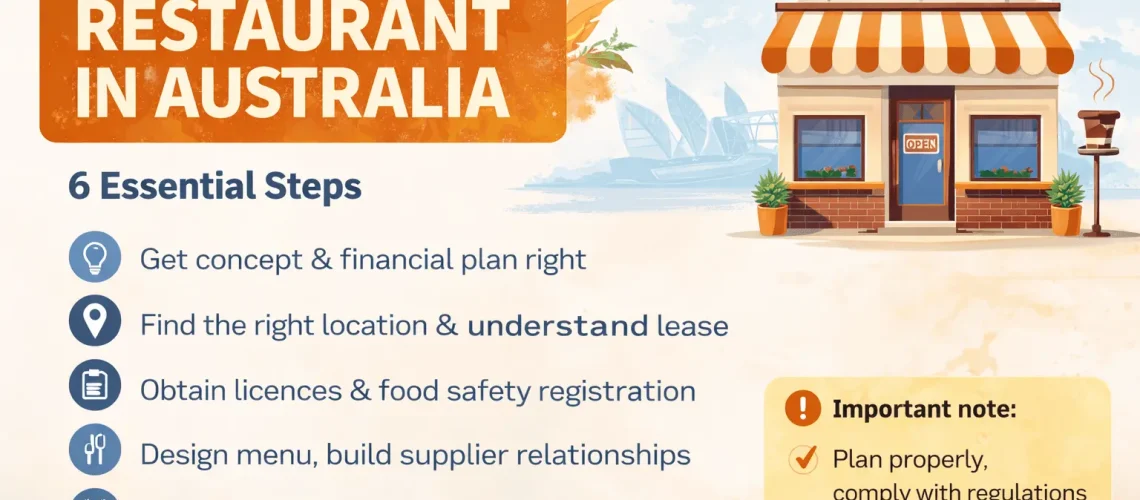
Here is a quick recap of the 6 steps we went through:
- Step 1: Get your concept right & build a financial business plan before you spend anything
- Step 2: Find a location that actually suits your concept & understand every line of your lease
- Step 3: Sort your licences & food safety registration before anything else
- Step 4: Engineer a profitable menu, build solid supplier relationships & set up a smart kitchen
- Step 5: Hire the right people, train them properly & pay them what they are owed
- Step 6: Set up your POS, ordering system & marketing before you open the doors
Whether you are starting with a ghost kitchen, a small suburban cafe or a full-service restaurant in Sydney, Melbourne or Brisbane, the process is the same. Start with the plan & everything else follows from there. Good luck. I genuinely hope it goes well for you.