



| Quick Summary: In Australia, restaurants usually make a gross profit margin of about 60 to 70 percent on food & drinks. But net profit margin, after rent, staff, bills & tax, is much lower, normally 3 to 9 percent. A good net margin for a restaurant is above 10 percent. Margins stay low because of high food cost, labour cost & rent. Owners can improve margin with better menu pricing, less food waste & smart tech like a pos system. |
What Is Restaurant Profit Margin?
Profit margin is simply how much money is left after you pay all your costs. It tells you how much of every dollar you earn actually turns into profit.
Say a customer pays $20 for a meal. If it costs you $14 to make & serve that meal, food, staff time, power, rent share, you keep $6. That $6 is your profit on that sale.
Restaurant owners track profit margin because sales alone dont tell the full story. You can have a busy restaurant every night & still be losing money if your costs are too high. Margin shows you the real health of the business.
"A lot of restaurant owners look at their bank balance & think they are doing fine. But without checking margin properly, you dont really know if the business is healthy or just busy," says Sarah Mitchell, a hospitality accountant based in Sydney.
Gross Profit Margin vs Net Profit Margin for Restaurants
What Counts as Gross Margin
Gross margin only looks at food & drink costs against sales. It does not include rent, wages, power bills or other running costs. Its mainly used to check if your menu pricing & food cost control are working.
What Counts as Net Margin
Net margin is the real number. It takes your total sales & subtracts everything, food cost, staff wages, rent, electricity, marketing, insurance, tax, all of it. What is left is your true profit.
How to Calculate Both
Gross Profit Margin equals Sales minus Food Cost, divided by Sales, times 100.
Net Profit Margin equals Sales minus All Costs, divided by Sales, times 100.
Example. Your restaurant makes $50,000 in sales this month. Food cost is $15,000. So gross profit is $35,000. Gross margin is 35,000 divided by 50,000, times 100, which equals 70 percent.
Now add all other costs, staff $18,000, rent $6,000, power & other bills $4,000, total costs $43,000. Net profit is 50,000 minus 43,000, which equals $7,000. Net margin is 7,000 divided by 50,000, times 100, which equals 14 percent.
This is why gross margin can look great on paper, 70 percent sounds amazing, but net margin tells the real story.
Whats the Average Restaurant Profit Margin in Australia?
In Australia, most restaurants sit in these ranges. Gross profit margin is usually around 60 to 70 percent. Net profit margin is usually around 3 to 9 percent for most restaurants, & cafes are normally a bit higher.
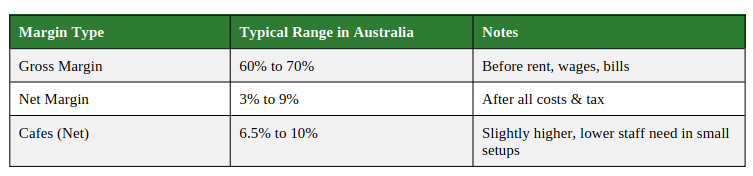
These numbers move around a lot depending on location, size, & how well the place is run. A restaurant in a busy Sydney or Melbourne CBD pays much higher rent than one in a regional town, & that eats straight into net margin.
"Rent & wages are the two biggest reasons Australian restaurant margins stay thin. Even a well run restaurant with great food can still end up under 10 percent net margin simply because of location costs," says David Chen, a restaurant consultant in Melbourne.
What Is a Good Profit Margin for a Restaurant?
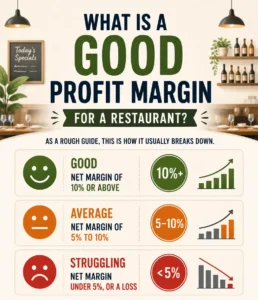
As a rough guide, this is how it usually breaks down.
● Good, net margin of 10 percent or above
● Average, net margin of 5 to 10 percent
● Struggling, net margin under 5 percent, or a loss
If your restaurant is sitting at 3 percent net margin, you are technically making money, but there is very little room for a bad month, a slow season, or a rent increase. Aiming for double digit net margin gives your business breathing room.
Profit Margins by Restaurant Type
Different formats have different cost structures, so margins are not the same across the board.
Fast Food Margins
Fast food restaurants usually run higher volume with lower prices per item. Net margins are often in the 6 to 9 percent range, helped by lower staff cost per sale & faster turnover, or no tables at all for takeaway only setups.
Fine Dining Margins
Fine dining looks fancy but often has the tightest margins. High cost ingredients, skilled chefs, low table turnover & expensive rent in prime locations all eat into profit. Net margins here are commonly 3 to 6 percent.
Pizza Restaurant Margins
Pizza has one of the better food cost structures in the industry because dough, cheese & basic toppings are cheap compared to the selling price. Gross margin on pizza can be 70 percent or higher, & with good volume, net margin often lands in the 10 to 15 percent range.
Sushi Restaurant Margins
Sushi margins depend heavily on fish cost, which moves up & down a lot. Good sushi restaurants that manage waste well & buy smart can see net margins around 8 to 12 percent, but poor portion control or high seafood prices can push this much lower.
Small or Independent Restaurant Margins
Small independent restaurants often run on tighter margins, usually 3 to 7 percent net, because they dont get the bulk buying discounts that bigger chains get on food & supplies.
Profit Margin on Food vs Alcohol
Food Margins
Food alone usually gives a gross margin of around 60 to 70 percent, but after cooking staff, kitchen equipment & wastage, the real contribution to profit is lower than it looks.
Alcohol & Wine Margins
Alcohol, especially wine & spirits, is where restaurants really make good margin. Markup on wine can be 200
to 300 percent, meaning gross margin on alcohol often sits between 70 to 80 percent, sometimes higher. This is why many restaurants push drinks menus so hard, alcohol sales often cover the thin margins from food.
"Food gets people through the door, but drinks are usually where restaurants actually make their profit. A good wine & cocktail list can make a real difference to the bottom line," says Priya Nair, owner of a Melbourne based restaurant group.
Why Are Restaurant Profit Margins So Low?
A few reasons keep margins tight across the industry.
● Food cost keeps changing, prices for meat, seafood & produce go up & down often, & menus dont always get updated fast enough
● Labour cost is high, Australia has strong minimum wage & penalty rates, which is fair for workers but adds real pressure to restaurant budgets
● Rent takes a big bite, especially in high footfall areas like shopping strips or city centres
● Utilities, insurance, licensing & compliance costs add up quietly in the background
● Food waste, over ordering, poor portion control & spoilage all reduce margin without owners even noticing
Delivery apps also cut into margin heavily. Commission fees from platforms can eat 20 to 35 percent of an order value, which is a major reason restaurants report lower profit on delivery orders compared to dine in
orders.
If you want to understand this cost properly, read our guide on how restaurants lose money with UberEats
& Doordash.
How to Improve Your Restaurants Profit Margin
Improving margin is usually a mix of small changes that add up.
● Menu engineering, price your menu based on actual food cost, not guesswork. Highlight high margin
items & rework or remove low margin ones
● Reduce food waste, track what gets thrown out each week & adjust ordering & portions
● Use smart ordering & tech, a good restaurant pos system helps you track sales, stock & staff hours in one place, so you can spot where money is leaking
● Improve online ordering setup, using your own food ordering system instead of relying only on delivery apps can save you a large chunk of commission fees
● Negotiate with suppliers, even a small discount on regular orders adds up over a year
● Upsell smartly, train staff to suggest drinks, sides or desserts, this lifts average order value without much extra cost
● Review costs regularly, do a proper swot analysis for restaurants every few months so you know your real strengths, weaknesses & where money is being lost
None of these need to be done all at once. Even fixing one or two of these areas can lift your net margin by a
few percentage points, which matters a lot when margins are already thin.
FAQs
Q1. What is a good net profit margin for a restaurant in Australia?
Anything above 10 percent net margin is considered good. Most restaurants sit between 3 to 9 percent though, so above 10 is solid.
Q2. What is the average profit margin for a restaurant?
Gross margin averages around 60 to 70 percent, while net margin averages around 3 to 9 percent in Australia.
Q3. Why is restaurant profit margin so low compared to other businesses?
High food cost, high labour cost, rent & extra fees like delivery app commissions all combine to keep margins thin.
Q4. Do restaurants make more profit from food or alcohol?
Alcohol usually has a much higher margin than food, often 70 to 80 percent gross margin, compared to 60 to 70 percent for food.
Q5. How can a restaurant increase profit margin quickly?
Fixing menu pricing, cutting food waste & using a pos system to track leaks are usually the fastest wins.
Conclusion
Restaurant profit margin in Australia is usually thin. Gross margin looks good on paper at 60 to 70 percent, but net margin often lands between 3 to 9 percent once all costs are counted. Margins change by restaurant type, fast food & pizza tend to do a bit better, fine dining & small independents often run tighter.
The good news is margin is not fixed. Small improvements in pricing, waste control, staffing & tech can genuinely move the number. If you are planning to start a restaurant or already running one, its worth checking our guide on how to start a restaurant in Australia to plan your costs properly from the start.